


So What’s Yours?
There’s nothing exciting about paper towels.
Or canned water.
Or toilet paper.
Or laundry detergent.
So imagine my delight when Brawny (yes, the paper towel brand) showed up with a rebrand so confident it made me pause mid-scroll.
And guess what?
They gave their lumberjack mascot a glow-up, redesigned their logo to look stronger (literally), and launched an unapologetically bold campaign to tell the world they’ve leveled up from 2-ply to 3.
A new ply. A new look. A new story.
Suddenly, paper towels aren’t just paper towels.
They’re strength.
They’re reliability.
They’re the hot, gentle giant who shows up when your life gets messy.
I saw this rebrand and thought:
If paper towels can have a compelling brand story...
What’s your excuse?
So What Happened?
Brawny didn’t redesign for fun.
Georgia-Pacific upgraded their entire product line from two-ply to three-ply, a 50% performance boost. (Which, in the home goods world, is kind of a big deal.) But they knew that change wouldn’t mean much if it didn’t look the part.
So they:
- Beefed up the logo: Flat black, bold strokes, and micro-serifs on the B and A that echo ranger-station architecture.
- Redesigned the mascot: A modern “gentle giant” built for today’s ad campaigns.
- Launched everything at once: New product update + new look + fresh cultural posture.
The result?
A commodity turned conversation piece.
And that’s what makes this whole thing so compelling:
It’s still paper towels.
But through branding and positioning, they became something more.
Tips for brands with legacy visuals: You don’t have to torch the past. Identify the one trait audiences cling to (plaid shirt, spark logo, signature color) and preserve it while updating everything else around it.
Your Product Isn’t Boring.
But your positioning might be.
Here’s what most founders miss:
People don’t buy the product.
They buy what the product means.
Brawny understood this.
They didn’t just say “Now stronger than ever.”
They told a story: of strength, dependability, and someone who shows up when life gets messy.
And this idea? It applies way beyond paper towels.
Want another perfect example?
Let’s talk about water.
You can’t get more basic than that.
And yet…
Liquid Death Made Water a Lifestyle
What’s more ordinary than water?
No one’s lining up to hear a pitch about “hydration.”
Unless… it’s packaged like rebellion.
Liquid Death took plain mountain water, wrapped it in a tallboy can, and gave it the attitude of a punk band on tour.
They didn’t sell health.
They sold chaos.
They made water feel dangerous, and weirdly fun.
“Murder your thirst.”
“Death to plastic.”
Their story is clear, loud, and unforgettable.
Suddenly, drinking water wasn’t just responsible.
It was cool.
It was a statement.
Same water.
New story.
Big market shift.
Story Sells. And It’s Everywhere.
We’re in an era where the best stories win.
Even if the product behind it is… well, basic.
Toothpaste brands are suddenly about self-expression.
Banking apps are about financial freedom.
Toilet paper is about softness and sustainability.
In a saturated market, your story is what makes someone pause.
Remember.
Feel something.
So What Can You Actually Do With This?
You don’t need a big agency or viral moment to start telling a better story. But you do need to be intentional about the signals your brand is sending.
Here’s how to start:
1. Find the Feeling
Don’t just describe what your product is. Define what it makes people feel.
✅ Instead of: “We sell handmade candles.”
➡️ Try: “We create small rituals of calm in chaotic days.”
That shift alone tells a different story, and helps shape your visuals, copy, and vibe.
2. Pick One Anchor, Then Evolve
If you’re refreshing your brand, don’t toss everything. Keep one element your audience already recognizes, and build around it.
✅ Example: Still using your old logo color because customers associate it with you? Great.
➡️ Modernize the typography, tone, or layout. But let that color be the bridge between old and new.
You’re not starting from scratch. You’re building from something familiar, but making it sharper, clearer, more current.
Read More: Our coca-cola content (how coca-cola made old campaigns sharper, clearer, more current.)
3. Show What Makes You Different, Fast
Your audience decides in about three seconds max, whether to keep scrolling or click away. In that tiny window, you need to answer one question:
“Why you?”
Start with this first framework, it’s quick, simple, and built for customer-facing copy like bios, packaging, and web headlines.
a. Framework 1: The 3-Second Uniqueness Grid
Best for fast, public-facing copy: Instagram bios, web hero sections, product labels.
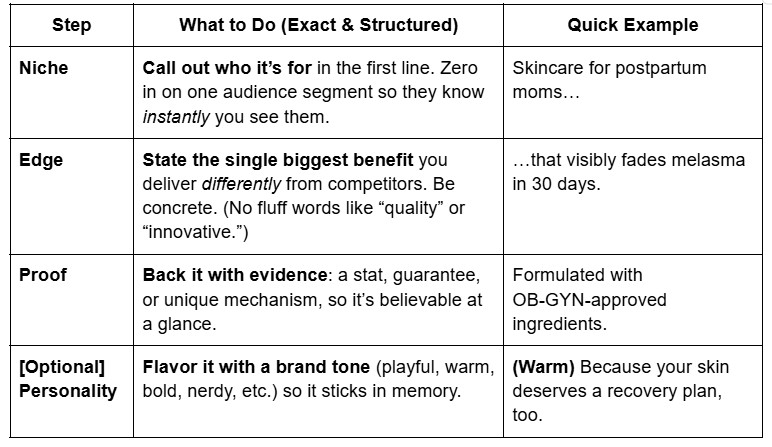
How to Use It:
- Write one crisp sentence per column, that’s your 3-second pitch.
- Test it aloud: If a friend can explain it back after hearing it once, you nailed it.
- Use it everywhere first impressions happen: your Instagram bio, website headline, hero banner.
Plug-and-play template:
[Product] for [Niche] who want [Edge], backed by [Proof]. [Optional - Personality quip].
—-----------
But what if you're not even sure what makes your brand different yet?
If you’re struggling to define your core value (or everything you’re saying still sounds generic) use this next framework to dig deeper before you start writing copy or designing visuals.
b. Framework 2: O → C → V
Best for internal clarity, before you design, write, or launch anything.
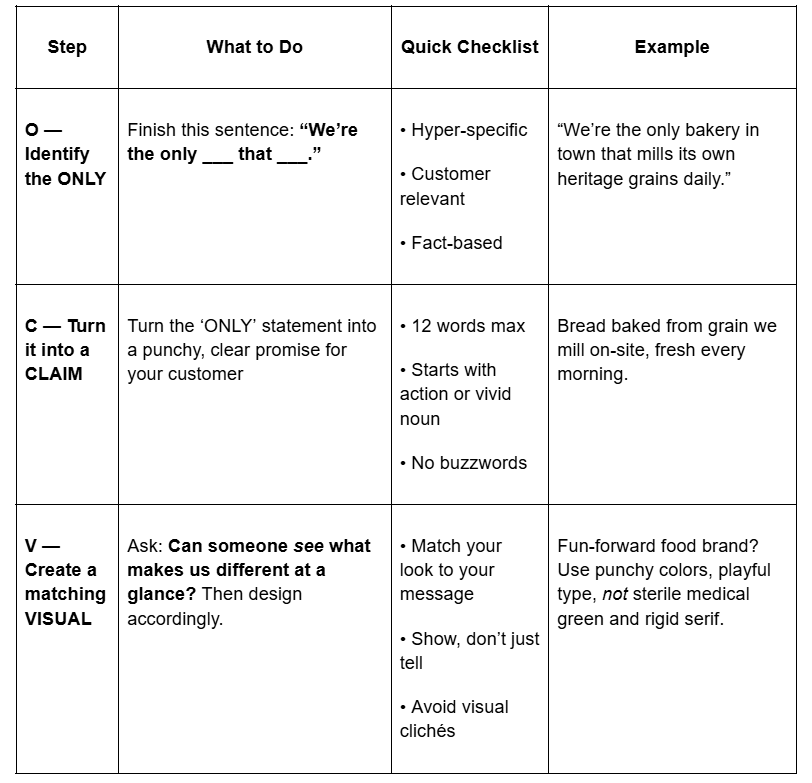
Why use it:
This is the groundwork. If your team or founder can’t agree on what your brand’s actual edge is, this framework forces clarity, so your marketing has a clear direction before you start writing or designing.
TL;DR:
- Use the 3-Second Grid when you need customer-facing copy right now: social bios, ads, email subject lines, above-the-fold web copy.
- Use O → C → V when you need to define or refine your unique value before design or messaging work starts.
Get these right, and even the fastest scroller will understand why you matter!
Peace,
Pik

Peace,
Pik
Kung Pik Liu • Founder of Design Angel
LinkedIn • Instagram • YouTube
Not sure what I do?
We help women entrepreneurs build brands as ambitious as they are—think brand strategy, brand identity, and marketing creatives. We do it all!
Want to see our work? Check it out!

