


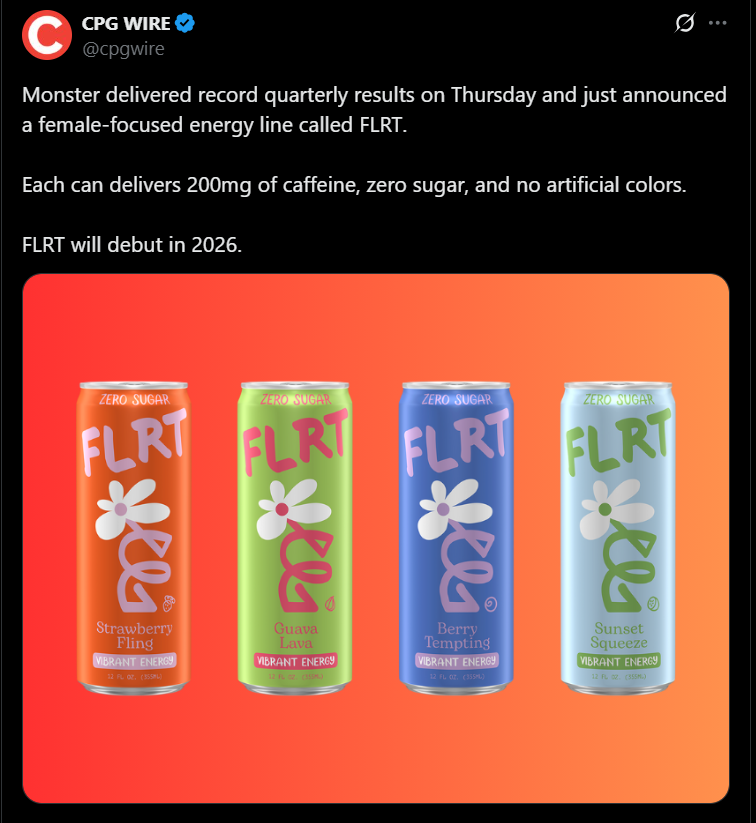
When I first heard that Monster Energy, the brand best known for motocross sponsorships, neon green claws, and “I haven’t slept in 48 hours” vibes, just launched a new energy drink “designed for women,” I had two reactions:
- Wait… Monster Energy?? For women??
- Okay I need to see this.
The line is called FLRT.
And on the surface, it’s a complete personality transplant from Monster’s legacy identity.
I was curious
Because here’s the truth:
Women don’t need more products.
We need products made with actual insight, not stereotypes.
FLRT positions itself around:
✨ zero sugar
✨ “beauty benefits”
✨ hydration
✨ blender-aesthetic colors
✨ collagen for hair/skin
It’s essentially energy-meets-beauty-wellness.
And aesthetically? It’s a total break from Monster’s extreme-sports masculine identity.
Let’s dive in.
For Women” Marketing Has a Long History of Missing the Point
Historically, “for women” marketing has been… rough.
Women have seen:
- pink pens
- pink razors
- pink earphones
- “diet” sodas meant to feel softer, lighter, “feminine”
And now, beauty-version energy drinks.
The problem isn’t the product.
It’s when the strategy is built around assumptions instead of audience truths.
What Monster Gets Right: Women Want Functional, Not Girly
Here’s the part I actually think Monster got right:
Women today care about functional, multipurpose, health-aligned products.
That’s why matcha, greens powder, adaptogens, kombucha, protein waters, and functional seltzers exploded.
FLRT taps into:
➡ hydration culture
➡ skin-first wellness
➡ light, refreshing flavors
➡ the “beauty from within” category
➡ energy without the “bro pre-workout” vibe
From a design lens: this is the direction women are moving toward.
Not “cute.”
Not “girly.”
But integrated into lifestyle and identity.
But here’s the gap.
Where It Misses: You Can’t Design “For Women” Without Talking To Women
You can always tell when a product was built with an audience versus for an audience.
If brands want to create for women, they need to start with women, not assumptions.
Questions Monster should have asked:
It feels like:
“Women don’t drink Monster, so… let’s make Monster cute.”
Instead of:
“What actually stops women from drinking traditional energy drinks?”
Questions Monster should’ve started with:
- Why do women avoid standard energy drinks?
- What’s the emotional barrier?
- What’s the functional barrier?
- How do women actually manage fatigue during the day?
- How do women talk about energy? (We don’t say “I need to get hyped.” We say things like “I’m drained,” “I need to function,” “I need focus.”)
- How do women perceive caffeine?
- What drinks do women choose instead, and why?
You can’t design a product for women if you never enter their world.
And in 2025, your audience can feel the difference instantly.
Gendered Marketing Needs to Evolve
Women aren’t asking for brands to make things “more feminine.”
We’re asking for brands to respect our routines, bodies, and culture.
The biggest thing brands still don’t understand:
Women don’t want cute.
Women want clarity.
Women want control.
Women want credibility, delivered in a language that feels like them.
FLRT gets the aesthetic right but misses the emotional insight.
It looks like something women would carry…
but it doesn’t sound like something women asked for.
If I Were Advising Monster Energy…
(And Monster, if you’re reading this, hi, call me.)
I’d tell them:
Don’t build a sub-brand around stereotypes.
Build it around data, co-creation, and lived experience.
Here’s what that would look like:
1. Run co-creation workshops with female consumers
Athletes, creators, wellness girls, office workers, night-shift nurses.
Let them shape the product voice.
2. Brand voice that speaks like a woman, not at women
Women don’t say “I need energy to crush my workout.”
We say things like:
“I’m exhausted.”
“I need to function.”
“I need to stay awake without dying.”
Speak our language.
3. Partner with experts
Female nutritionists, doctors, sports coaches, dietitians.
Not just influencers.
4. Show women in real contexts
Not staged gym settings.
Think:
- late-night work
- school drop-offs
- beauty routines
- care responsibilities
- creative hustle
Because women don’t get tired in one setting, we get tired everywhere.
5. Build purpose into the product, not just packaging
Donate to women’s health initiatives.
Support female athletes.
Collaborate with women-led wellness brands.
Make FLRT a movement, not a marketing invention.
What FLRT Teaches Us About Branding Today
The lesson isn’t about Monster.
It’s about modern branding.
Consumers today, especially women, expect brands to treat them as partners, not personas.
So if you're creating a product “for women,” your job is not to guess what women want.
Your job is to listen, co-create, collaborate, and build with respect.
Because design isn't about making things look pretty.
It’s about making people feel understood.
My Final Take
I don’t think Monster’s FLRT is a bad idea.
I think it’s an incomplete idea.
Beautiful on the outside.
Missing a layer of insight on the inside.
And that’s the biggest branding risk today:
Not ugliness.
Not simplicity.
Not minimalism.
But superficiality.
If you want women to buy your product, remember:
We don’t respond to cute.
We respond to care, clarity, and cultural awareness.
And Monster, if you want FLRT to become more than a pastel can on a shelf?
Start by inviting women into the room.

Peace,
Pik
Kung Pik Liu • Founder of Design Angel
LinkedIn • Instagram • YouTube
Not sure what I do?
We help women entrepreneurs build brands as ambitious as they are—think brand strategy, brand identity, and marketing creatives. We do it all!
Want to see our work? Check it out!

